The Animal Welfare (Scotland) Regulations 2021 – The Scottish Government
Click to view the report
The Guidance on Licensed Dog Breeding echoes much of the English Regulations and Guidance and includes the Condition: No dog may be kept for breeding if it can reasonably be expected, on the basis of its genotype, conformation, behaviour or state of health, that breeding from it could have a detrimental effect on its health or welfare or the health and welfare of its offspring. It states that licence holders must be aware of breed specific health risks and that appropriate health screening relevant to the breed should be carried out.
The Guidance specifically recommends caution in regard to the Kennel Club’s category 3 breeds, ie those breeds identified as having extreme physical features which predispose them to health and welfare problems.
The International Partnership for Dogs (IPFD) facilitates the collaboration and sharing of resources to enhance the health, well-being and welfare of pedigree dogs and all dogs worldwide. Its goal is to facilitate the sharing of knowledge across all stakeholders worldwide. It has initiated specific actions to improve dog health and well-being, such as supporting globally relevant breed-specific breeding strategies. A major development has been the project, Harmonisation of Genetic Testing for Dogs (HGTD), which is regularly updated and provides a breed relevance rating (BRR). The next International Dog Health Workshop (DHW) will be in 2022.
Responsible Dog Breeding Guidelines 2020 – European Commission – Welfare in Pet Trade
Click to view the report
The EU Responsible Dog Breeding Guidelines 2020 reminds us of the close bond, understanding and communication between dogs and humans. The Report reminds us that poor breeding practices have profoundly detrimental effects on dog welfare and on the well-being of owners. Poor breeding may lead to a lifetime of suffering, through poor health and poor suitability as pets, resulting in an untimely death, abandonment or relinquishment. Dogs and puppies have the same need for a good quality of life regardless of breeding context and all breeders are required to act responsibly and with compassion to meet those needs.
The Guidelines are intended to support enforcement of responsible breeding and good animal welfare practices by competent authorities. The criteria for good practice are set out in these guidelines.
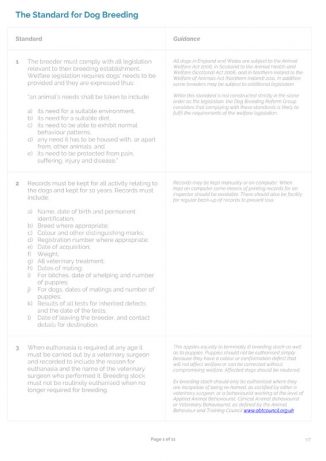
This detailed Standard for Dog Breeding was adapted from an original Standard written by the Advisory Council on the Welfare Issues of Dog Breeding. When the Advisory Council’s term came to an end in 2014 the Standard was updated and became the DBRG Standard and Guidance for Dog Breeding. The Standard has been superceded by the 2018 Government Guidelines on Dog Breeding and in 2020 by the Code of Practice for Dog Breeding. The Standard for Dog Breeding remains a practical, relevant and detailed document for those who wish to breed dogs according to the highest ethical criteria.
This report describes the legislation in place across the EU for the protection of dogs and cats. It confirms the wide variation across countries and highlights substantial gaps in the national legislation in protecting dogs and cats used in breeding and selling. The report recommends compulsory permanent identification on a appropriate database linked to an EU database; compulsory licensing of cat and dog breeders and harmonised EU standards for breeders; a ban on third party sales of dogs and cats; appropriate controls on internet sales; specific requirements for the transport of dogs and cats in the context of economic activity; controls on the internet trade of cats and dogs; a ban on surgical mutilations. Fifteen out of 28 member states have legislation to prevent the selective breeding of dogs and cats with genetic problems such as inherited disease or exaggerated conformations.
The Code of Practice for Dog Breeding sets the standard for care and management of breeding dogs and their offspring. It applies to all dogs used for breeding (both male and female) and all the puppies produced, regardless of whether a breeder is licensed or not. It is particularly relevant in the light of the current ‘pandemic puppy’ welfare emergency where inexperienced dog owners are cashing in on the demand for puppies and charging extremely high prices for them.
Improving the implementation of animal welfare legislation in animal breeding 2020 – Finnish Food Authority
Part 2: Preliminary analysis of problems and means of intervention in the breeding of dogs
Click to view this report
The Report focuses on the hereditary characteristics of significant welfare factors that require the urgent implementation of the Animal Welfare Act. It focuses on the health of brachycephalic (short-skulled) dogs and concludes that if the welfare problems caused by exaggerated features are tackled solely by means of health examinations without changing the physical characteristics themselves those welfare problems will persist. It concludes that lasting results can only be achieved by changing those characteristics.
The Animal Welfare (Licensing of Activities Involving Animals) (England) Regulations 2018 – Guidance notes for conditions for breeding dogs – Updated April 2020 – DEFRA
Click to view the report
The Guidance notes outlines the conditions that must be complied with in order to obtain an animal activities licence for the activity of breeding dogs. Such businesses are awarded a licence on the basis of a risked-base, star rated system and must comply with the 2006 Animal Welfare Act. Dog breeding businesses are encouraged to achieve a higher rating.
Schedule 6 includes: No dog may be kept for breeding if it can reasonably be expected, on the basis of its genotype, phenotype or state of health that breeding from it could have a detrimental effect on its health or welfare or the health and welfare of its offspring.
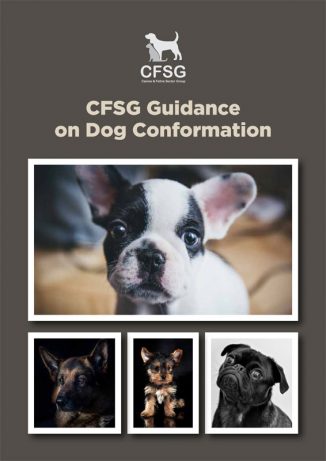
The CFSG Guidance on Dog Conformation is intended to educate, inform and improve public awareness about dog conformation and its impact on dogs and wider society. It supports the Regulations relating to breeding and provides practical guidance for anyone breeding, selling or buying a dog whether for the purpose of further breeding or as a family pet. It highlights some of the key conformational aspects to look for in a dog when making decisions decisions on whether to breed from or acquire a dog.
If intending to breed from a dog, the Guidance can be used in conjunction with the legislation and related guidance to determine whether or not to breed from either potential parent. It should also be used in conjunction with the Code of Practice for Dog Breeding.
The Scottish SPCA Assured Breeders Scheme is intended to ensure that members of the public buy puppies from reputable breeders and don’t fall into the trap of buying from a puppy farmer or illegal puppy dealer. The Scheme endorses good, ethical breeders who breed to the highest health and welfare standards. The Welcome Pack includes information for both breeders and buyers, including a Puppy Contract. The Welcome Pack also includes appropriate health screening to ensure dogs are of good physical, mental and genetic health.