Animal Welfare Act 2006 and Code of Practice for the Welfare of Dogs 2010
The United Kingdom”s Animal Welfare Act was passed in 2006 which makes it an offence to mistreat or neglect an animal for which someone is responsible. A person may be prosecuted by the RSPCA, Local Authority or Police for failure to uphold the welfare principles of the Act.
In 2010 the Department for Environment, Food and Rural Affairs produced a Code of Practice for the Welfare of Dogs as a guide to dog owners, local authorities and RSPCA of a dog’s needs under the Animal Welfare Act.
A dog’s basic needs must be met:
its need for a suitable environment
its need for a suitable diet
its need to be able to exhibit normal behaviour
any need it has to be housed with, or kept apart from, other animals
its need to be protected from pain, suffering, injury and disease
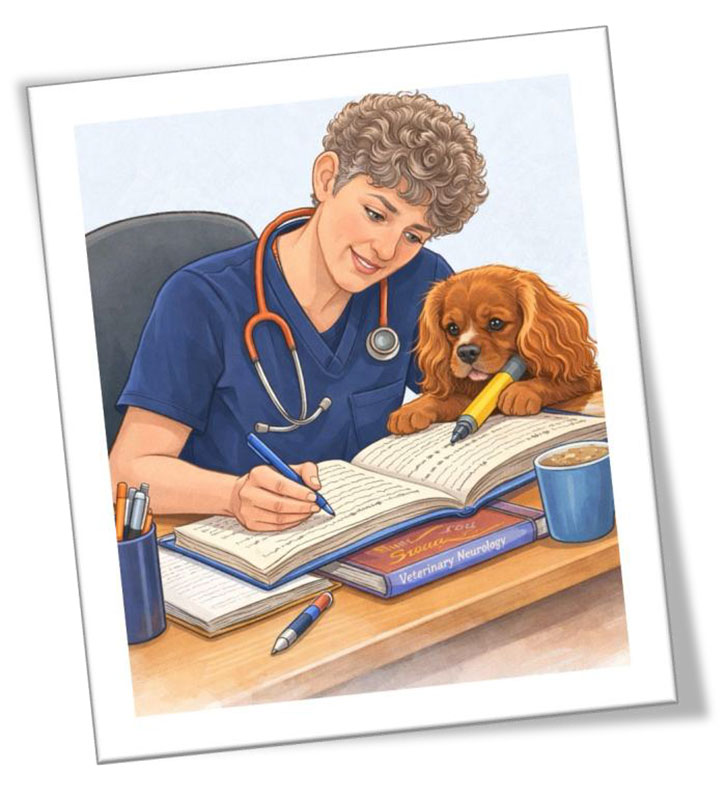
In these two videos, Clare explains what happens to the ageing brain in dogs and cats and how veterinarians diagnose Cognitive Dysfunction Syndrome (CDS) — the animal equivalent of dementia.
Professor Clare Rusbridge has shared a positive and encouraging update from research made possible by the Cavalier Tissue Collection Scheme. For those whose Cavaliers were part of this project, it is heartening to know that their legacy is already helping to deepen understanding of syringomyelia and may lead to better outcomes for future dogs.
A recent study, carried out by researchers at the University of Copenhagen, explored why some Cavaliers with syringomyelia (SM) develop severe, difficult-to-control neuropathic pain. Using advanced techniques to study spinal cord tissue, the research identified changes in key support and immune cells that appear to drive inflammation and chronic pain.
These findings mark an important step forward in understanding the biological processes behind syringomyelia-related pain and could help guide improved treatments and pain management in the future.
This research would not have been possible without the quiet generosity of owners who chose to donate their beloved dogs to science, along with the dedication of vets, researchers and fundraisers. We extend our heartfelt thanks to everyone involved in the Cavalier Tissue Collection Scheme, including Margaret Carter and Cavalier Matters whose work continues to make a lasting difference.
Above all, thank you to Clare Rusbridge for her tireless dedication to Cavalier health. Through research, collaboration and compassion, she and her colleagues are helping to shape a healthier future for this much-loved breed.
Prof. Clare Rusbridge has released an interactive CM/SM treatment plan (algorithm). The Plan includes easy-to-use links to her YouTube videos, which explain the symptoms, treatment choices, and other things vets and owners can do to help their suffering Cavaliers.
Owners are reporting that the videos are incredibly helpful for them and their veterinarians. Managing pain and improving the quality of life for Cavaliers (or other breeds that suffer from CMSM) can be difficult when the condition is severe.
One thousand dog owners have now used Chiari Check to ascertain their dog’s risk of Canine Chiari and Syringomyelia. The simple-to-use triage tool was developed from the clinical data of hundreds of Professor Clare Rusbridge’s clinical cases and the algorithm developed by Kristina Ivanova (supervisor) and Mariam Cirovic of the University of Surrey.
Everything you need to know about Canine Chiari Malformation and/or Syringomyelia.
Dr. Clare Rusbridge’s Frequently Asked Questions web page is up and running! Please visit for more information about Canine Chiari Malformation and/or Syringomyelia (CM/SM) affecting the Cavalier King Charles Spaniel:
Recently there has been news about a search for a gene which is still in the early stages, may help protect Cavaliers against early onset Myxomatous Mitral Valve Disease (MMVD). This gene is called the NEBL3 gene.
Dougall is 17 years and 2 months. He was first diagnosed with a murmur at age 11; is regularly checked by the vet and cardiologist and remains B1 (earliest stage of the disease with no heart enlargement), NO medication for his heart.
As Dougall has remained stable we decided to carry out the DNA test.
The MMVD result was a surprise – his result was genetically affected for Myxomatous mitral valve disease [MMVD]. To date, 97% of Cavaliers have this result.
Even though we were surprised at the result we hope this will give re-assurance and comfort to people who have a similar result.
Further Reading
Dr Dougall’s MMVD Research Results
The 2022 Australian NEBL3 study (which is not even in the pilot study stage) found 6 NEBL3 cavaliers; 5 of which they had diagnosed as having Mitral Valve Disease before the study began. However all 5 had milder cases of MMVD than the average of the other dogs in the study.
It is hoped that future studies with more NEBL3 cavaliers will show that the NEBL3 mutation slows down the progression of Myxomatous Mitral Valve Disease (MMVD) in the breed.
Swedish Research News
A mandatory heart screening program was introduced in Sweden and the risk of dying before age 10 is now almost half of what it was prior to the program; early cases of heart murmurs and heart failure is almost gone from the Swedish population. However the Swedish breed club stated that Mitral Valve Disease and Syringomyelia are near to impossible to extinguish in a screening programme unless new genes are added to the breed. The Finnish and Swedish Cavalier King Charles Spaniel Clubs have started cross-breeding programs to improve the health of the breed.