This Report aims to help Breed Clubs and Breed Health Co-ordinators embark on a process designed to improve the overall health of their breed. Attention is paid to identifying the specific health problems of the breed and addressing in-breeding and genetic diversity.
This Report looks primarily at the state of well-being of the nations pets. It is structured around owners’ knowledge and application of the Animal Welfare Acts 2006 and the five Welfare Needs that are enshrined within them. It highlights the areas of well-being that still require improvement.. for dogs this includes obesity and insufficient exercise. The Report also finds that 24% of dogs are left alone for more than 5 hours a day and 24% of owners did not see the puppy with its mother.
How in tune are we with the needs of our canine companions? – The RSPCA
Click to view the report
In this Report the RSPCA publishes its research on dog ownership in the UK. There are an estimated 11.5 million dogs in the UK and a quarter of all households share their homes with a dog. The Report asks how much do owners understand about the needs of their dog to ensure that they are physically fit and psychologically fulfilled. Some of the Reports findings are that 22% of dogs spend four hours or more alone each working day. Nearly half of all dogs get between 30 and 60 minutes exercise every day but 20% of dogs are never let off the lead. Most owners agree that dogs need regular opportunities to play. Only 39% of owners attend training classes.
This is DBRG’s the first Annual Report in which an outline of its activities during 2017 are outlined. It precedes the official registration with the Charity Commission as a registered charitable trust (No. 1176163). Highlights include the first DBRG Symposium in collaboration with the University of Surrey Vet School in October and attendance at the international Dog Health Workshop in Paris in April. Several position papers were completed as well as written submissions to key Government consultations associated with animal welfare.
Following a consultation process, Defra published its Report outlining the Next Steps in the Review of Animal Establishments Licensing. The intentions are to create new Model License Conditions for Dog Breeding which will become law. No puppies may be sold under eight weeks; the statutory licensing threshold will be three or more litters; each breeding bitch should have no more than one litter a year; there will be a requirement for licensed breeders to display their local authority licence number when advertising; local authorities will be required to use a risk-based system, including a consideration of an affiliation to a body accredited by UKAS, such as the Kennel Club Assured Breeders Scheme (ABS).
The case for a more cohesive approach to pet welfare legislation – Blue Cross
Click to view the report
This Report paints a picture of the current state of statutory enforcement of pet legislation in Britain. Local authorities are responsible for running a licensing system for dog breeding establishments. However, a lack of personnel and appropriate training, together with slashed budgets, has left many of them without the resources and confidence to deal with animal welfare legislation suitably and effectively. There are issues around consistency and clarity of duties and resource levels mean that the majority of local authorities only have the capacity to deal with licensed premises. The scale of the unlicensed and invisible trade makes this a serious welfare concern.
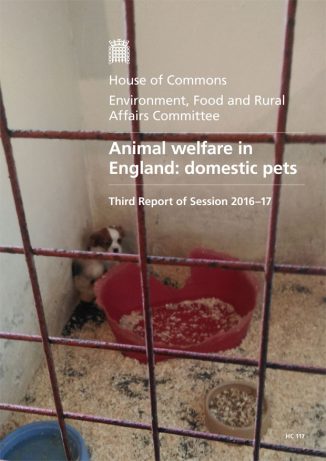
The Government responds to each of the recommendations of the Environment, Food and Rural Affairs Committee Report: Animal Welfare in England: domestic pets. New regulations will be in place in 2018 for animal activities licensing. Regarding the progeny of dogs the Government cites the Kennel Club’s Assured Breeders’ Scheme which requires the genetic screening of dogs to reduce the risk from inherited conditions. (In the view of DBRG these are minimal). ‘We will explore the possibility of further protecting the progeny of dogs within the proposals to modernise the dog breeding regulations. The Government rejects Efra’s proposals to ban the third party sale of puppies on the grounds that sales would be driven underground.
In 2008 a BBC documentary called ‘Pedigree Dogs Exposed’ drew attention to the health problems in Kennel Club registered dogs, by showing dogs in pain due to exaggerated show features and inherited diseases due to inbreeding.
This led to two reviews of dog breeding; the first from a group of MPs ( APGAW ) and the second, chaired by Professor Bateson, that recommended some important changes which include:-
An independent council would advise on ways to stop breeding for exaggerated show features, the spread of inherited health problems and inbreeding.
All puppies should be seen with their mothers, and microchipped before they leave their breeder.
An Accredited Breeders Scheme where parents of puppies must be health checked, and only used for breeding if they pass the tests.
There should be a drive to educate pet owners what they should look for when buying a puppy.
Improved rules would allow local authorities to enforce breeders’ duty of care to their dog.
The group has 90 political members from both the House of Commons and the House of Lords.
Carol Fowler has successfully campaigned the Government to provide protection for dogs from suffering at the hands of greedy breeders.
A BBC production ‘Pedigree Dogs Exposed’ found that 75% of the seven million dogs in the UK are pedigrees, and they cost their owners over £10m in vet fees every year. The in-depth investigation suggests dogs are in serious trouble, plagued by genetic disease due to decades of inbreeding.
The are also suffering acute problems because of the show ring’s emphasis on looks over and above function and health.
The APGAW inquiry report published on 3rd November 2009 ‘A Healthier Future for Pedigree Dogs’ issued their recommendations giving the Kennel Club a year to enforce the changes among breeders and breeding societies.
Pedigree Dog Breeding in the UK:
A major welfare concern? Dr Nicola Rooney & Dr David Sargon
An independent scientific report commisioned by the RSPCA.
This report identified that many dogs of different breeds experience compromised welfare due to the effects of selective breeding practices. It identified two welfare issues: exaggerated anatomical features that reduce quality of life; and the increased prevalence of inherited disorders.
It endorses the findings of the CAWC Report of 2006 that the welfare issues are serious and widespread. The report suggests that measures taken so far to reduce or eradicate these problems have had only limited success, due in part because most screening programs are voluntary.
The report’s recommendations include: systematic collection of disease and mortality data; banning close matings; opening stud books; an ethical review of all breeds; increasing genetic diversity; making registration of dogs conditional on the health screening of parents; introducing codes of practice that prioritise health, welfare and temperament; educating the public that a desirable dog is one that experiences high welfare; the development of schemes for calculating estimated breeding values (EBVs) for genetic diseases.